


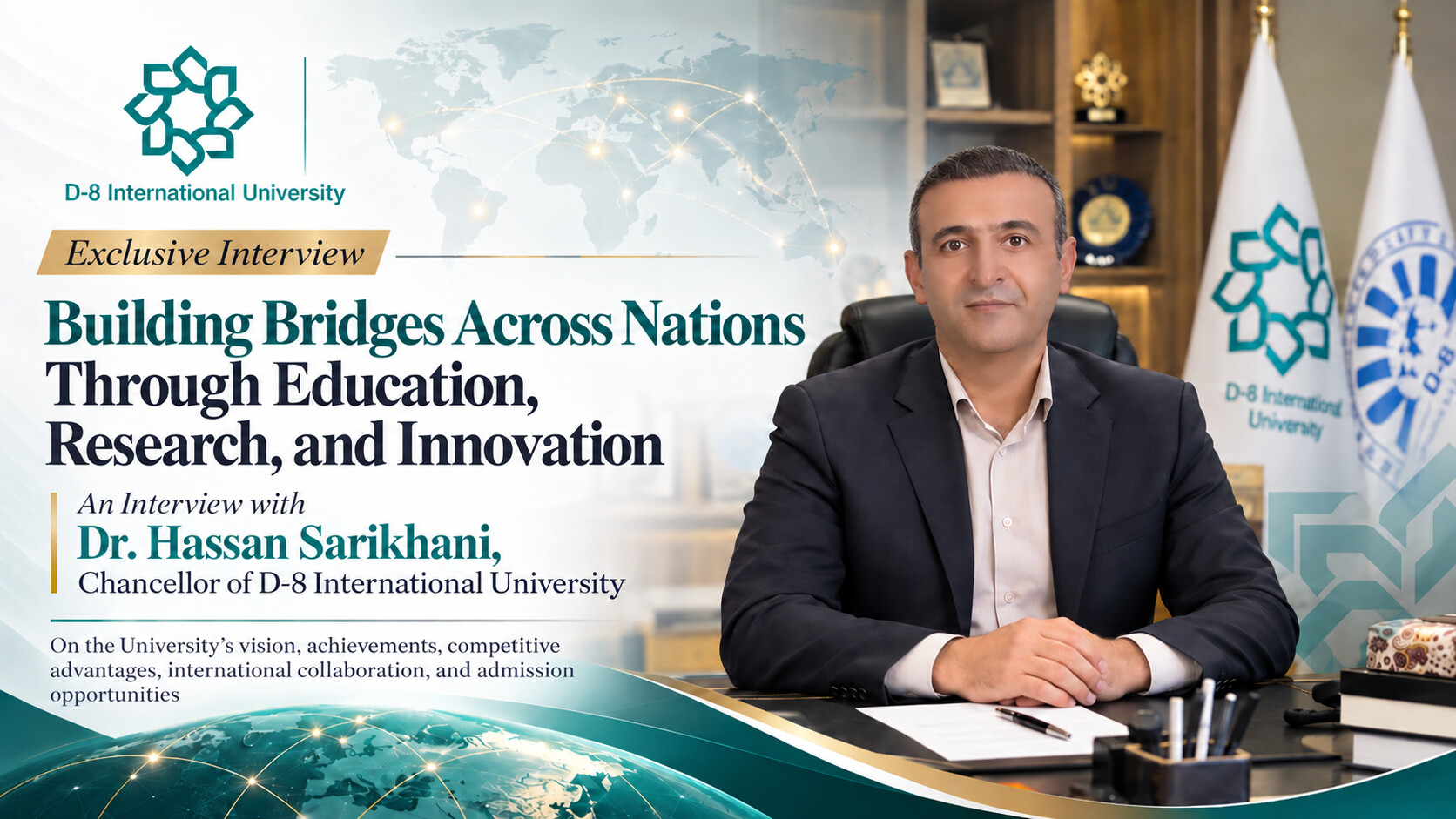
D-8 International University: A New Model for Global Academic Cooperation
D-8 International University: A New Model for Global Academic Cooperation
An Interview with Dr. Hassan Sarikhani, Chancellor of D-8 International University
In a world where knowledge crosses borders faster than ever, a new kind of university has emerged, one with a diverse presence across many campuses, built uniquely on connection. D-8 International University brings together the academic strengths of eight nations: Bangladesh, Egypt, Indonesia, Iran, Malaysia, Nigeria, Pakistan, and Türkiye. We spoke with Dr. Hassan Sarikhani, the University's Chancellor, to understand what makes this institution different, how it works, and where it is headed.
You lead a university that doesn't look like a traditional university. How would you describe it?
Dr. Sarikhani:
That's the right question to start with, because D-8IU really is a different kind of institution.
We are not a university with one big campus and a fixed set of buildings. We are a network. Think of us as a bridge that connects universities, researchers, and students across eight countries.
Each of our member states already has excellent universities, talented professors, and strong research facilities. What we do is connect those strengths. A student at D-8IU is not limited to one campus. They can work with professors in Malaysia, conduct research in Iran, take courses from Pakistan, and collaborate with peers in Indonesia, all within one academic experience.
We currently have more than 41 universities in our network. And we are connected not only within the D-8 region but also with institutions in other parts of the world.
So, when people ask what D-8IU is, I say: we are a university without walls. Our campus is the entire D-8 community.
What makes this model work? Why not just build a traditional university?
Dr. Sarikhani:
Because the traditional model has limits and we wanted to do something more ambitious.
A traditional university depends on its own faculty, its own laboratories, its own library. That works well, but it also means you are limited by what you have on your own campus.
We asked a different question: what if we could give students access to the best of eight countries at once?
That is what our network does. If a student needs a specific laboratory that exists in Malaysia, they can go there. If a professor in Nigeria is working on a problem that a researcher in Iran is also studying, we connect them. If a university in Bangladesh has expertise in water management, we bring that expertise into our joint programs.
We are not competing with existing universities. We are connecting them. Our strength comes from the network, not from a single campus.
How does this work in practice for a student?
Dr. Sarikhani:
Let me give you a concrete example.
A PhD student in our International Bridge Initiative might start their research at a university in Pakistan. Through our network, they spend time at D-8IU in Iran to use specialized research facilities. Their supervisor might be from Malaysia. Their research might be part of a joint project involving researchers from Nigeria and Indonesia.
When they graduate, they receive a dual degree recognized by both institutions. But more importantly, they leave with an international network of contacts, experience in different academic environments, and a research profile that is genuinely global.
That is the D-8IU experience. It is not just about getting a degree. It is about becoming part of a global academic community.
The University has a strong focus on research. What are you working on?
Dr. Sarikhani:
Our research is built around problems that our member countries share because these are problems that no single country can solve alone.
We focus on three main areas: water, environment, and population.
Water is our flagship. Through our Scientific Water Saviors initiative, we have brought together 65 experts from 21 leading institutions across the D-8 countries. They are working on sustainable water management, efficient irrigation, water purification, and access to safe water. This is not just a research project. It is a practical effort to address a real challenge that affects millions of people.
Our environmental research looks at climate action, green technologies, biodiversity, and sustainable natural resource management.
Our population research examines migration, urbanization, youth employment, aging populations, and regional development.
And we are developing an international scientific journal a platform where researchers from D-8 countries and beyond can publish their work and share their findings with the global academic community.
You also emphasize something called "scientific diplomacy" What does that mean?
Dr. Sarikhani:
It means using science as a way to build relationships between countries.
The D-8 countries have different cultures, different economies, different political systems. But when scientists work together on a shared problem — like water scarcity or climate change those differences become less important. They focus on the science.
We have seen this happen again and again. When researchers from Iran and Malaysia work together on a water project, they are not thinking about politics. They are thinking about how to solve a problem. And that creates trust, understanding, and long-term relationships.
This is one of the most valuable things D-8IU can do. We are not just producing research. We are building bridges between nations.
What programs do you offer?
Dr. Sarikhani:
We focus on graduate education, Master's and PhD levels.
Our fields are broad: science, engineering, technology, agriculture, natural resources, veterinary sciences, management, economics, humanities, social sciences, law, arts, and architecture.
But we are particularly interested in interdisciplinary work. Many of today's most important problems such as water, climate, food security, digital transformation, cannot be solved within a single discipline. So, we encourage students and researchers to work across boundaries.
We offer joint degree programs, dual degree programs, joint PhD initiatives, student and faculty exchange, and international research projects.
And we are developing new programs all the time including programs in the literature and languages of our member countries.
What about students who want to join? How do they apply?
Dr. Sarikhani:
We have worked hard to make the process simple and accessible.
Students can send an email directly to our Admissions Office at d8iuadmission@gmail.com . They just need to include their name, the program and degree level they are interested in, and their country of origin. Our team will guide them through the process step by step.
We welcome qualified students from D-8 countries and from other parts of the world.
And we want to make it affordable. Students from D-8 member countries may be eligible for tuition discounts of up to 50 percent. We also offer scholarships, research support, and sponsorship opportunities.
Our goal is simple: to make world-class graduate education accessible to talented students, regardless of their financial situation.
What are the tuition fees?
Dr. Sarikhani:
Our fees are competitive with international standards:
Field of Study | Master's | PhD |
Humanities | €2,500 | €4,000 |
Non-Humanities | €2,900 | €5,000 |
And as I mentioned, students from D-8 member countries may be eligible for discounts of up to 50 percent.
We are also working to develop more scholarship opportunities, research grants, and full or partial sponsorship through public and private institutions.
We want cost to be a bridge, not a barrier.
What is your vision for the future of D-8 International University?
Dr. Sarikhani:
Our goal is clear: we want D-8IU to become a leading academic bridge among the D-8 countries and between our region and the wider world.
We want to be known for international cooperation, joint research, academic mobility, innovation, and science that addresses real problems.
And I say this with real pride: our International Affairs Office has built strong, high-level networks with Ministers and Ministries of higher education, leading universities, and with high rank scholars across the D-8 countries and beyond. That is not something every university can claim. It is a unique window for us.
This is not just a figure of speech. Our Board of Trustees brings together the highest academic officials from our member states, Ministers of science, higher education, and technology, alongside the D-8 Secretary-General, the Head of our Founding University, Distinguished Scientists, and our own Chancellor. The Board is our highest decision-making body, and it meets regularly to set policy, approve programs, and guide the University's future. When ministers sit at the same table as researchers and university leaders, decisions are not made about us from the outside, they are made with us, together.
This is why we at D-8IU have always seen ourselves as part of the D-8 countries' academic ecosystem not outside of it. This is not a slogan. It is a deep belief in who we are.
Because of these connections, we can take a scientific idea and actually implement it across the D-8 community. Whether it is a joint research project, a new academic program, or a shared laboratory initiative we have the relationships, the trust, and the intergovernmental support to make it happen.
We are grateful for this. And we take it as a responsibility, not just an honor.
D-8IU: A University Beyond a Single Campus
D-8 International University is a network-based international university that connects the academic capacities of eight countries, Bangladesh, Egypt, Indonesia, Iran, Malaysia, Nigeria, Pakistan, and Türkiye.
It is more than a conventional university. It is a bridge connecting universities, researchers, innovators, and the next generation of scholars across the D-8 community and the world.
About D-8 International University
D-8IU is an intergovernmental academic institution established within the framework of the D-8 Organization for Economic Cooperation. The University focuses on graduate education, international research, academic mobility, innovation, and scientific cooperation among D-8 countries and with the wider international academic community.
Contact Information
D-8 International University
Hamedan, Iran
Website: https://iu.d8.int
General Inquiries: Info@iu.d8.int
Admissions: d8iuadmission@gmail.com
Tel: +98-81-38276655
Related News
D-8 International University: A New Model for...
D-8 International University is redefining global higher education through a collaborative...
Call for Participation in the International...
D-8 International University invites students and staff to participate in the online iYEC...
D8 International University and Tehran...
D8 International University and Tehran University of Medical Sciences have signed an MoU to...
Global Call for Papers: Universitas Brawijaya...
Universitas Brawijaya, Indonesia, has issued a global call for papers for the 3rd...
Universiti Kebangsaan Malaysia (UKM) Invites...
Universiti Kebangsaan Malaysia (UKM) has announced a global call for its 2026 Summer...
D-8 International University and University of...
D-8 International University and the University of Kurdistan have signed a cooperation...
Universiti Teknologi MARA to Host the 3rd...
Universiti Teknologi MARA (a D-8IU partner) is hosting the 3rd SDG Innovation Virtual...
D-8 International University Expresses Deep...
Chancellor of D-8 International University...
The Chancellor of D-8 International University congratulated everyone on the arrival of the...
New Year 2026 Message from the Chancellor of...
The Chancellor of D-8 International University extended New Year 2026 greetings, emphasizing...
Mehran University of Engineering and Technology...
Mehran University of Engineering and Technology (MUET) will host the 8th International...
D-8 International University Promotes...
D-8 International University highlights an upcoming UNESCO-led international webinar on the...

Useful links
SAORG Portal D-8 Organization for Economic Cooperation Ministry of Education of Bangladesh Ministry of Higher Education & Scientific Research of Egypt Ministry of Education, Culture, Research and Technology, Republic of Indonesia Ministry of Science, Research and Technology of Iran Ministry of Higher Education of Malaysia Federal Ministry of Education of Nigeria Higher Education Commission, Islamic Republic of Pakistan Council of Higher Education of Turkey
D-8 International University
Address: Hamedan, Farhang Street
Phone number: +988138276655 +988138282038
Fax number: +988138276655
Postal Code: 65157-45566
info@iu.d8.int

Connect with us


Page Comments